
Advanced Conveyor Systems for Pharmaceutical Production
Home » Industries We Serve » Pharmaceutical Conveyors
Engineering for Compliance, Precision and High-Speed Reliability
Pharmaceutical production lines demand a level of consistency and control that simply doesn’t exist in other manufacturing sectors. With batch traceability, regulatory scrutiny, contamination risks as well as the strictest of hygiene standards, every mechanical process must operate with absolute predictability. Pharmaceutical Conveyors sit at the centre of that workflow.
What is a Pharmaceutical Conveyor?
A conveyor system in a pharmaceutical facility is not a passive component, it is a controlled mechanical environment that:
- Maintains correct product orientation
- Ensures repeatable transfers between equipment
- Supports cleanroom standards
- Reduces manual handling
- Prevents micro-stoppages and vibration interference
- Integrates with automation and inspection systems
- Ensures cleaning can be carried out efficiently and thoroughly
IDC Conveyors specialises in eliminating these weaknesses by manufacturing and installing high-precision, hygienic conveyor engineering tailored to the pharmaceutical sector.
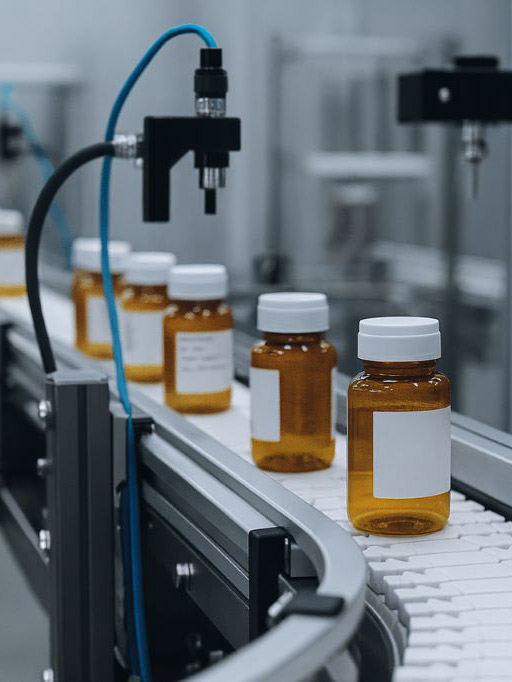
Understanding the Challenges of Pharmaceutical Material Handling
1) Maintaining Cleanroom Integrity
Pharmaceutical plants often operate across multiple cleanroom grades (ISO 5–8). Conveyors must be built without horizontal surfaces, with minimal harbourage points and with components capable of withstanding frequent sanitisation. Even small gaps in belt edges or roller assemblies can harbour particulates and microbes so being precise is absolutely crucial.
2) Preventing Product Instability
Lightweight bottles, ampoules and blister packs can be prone to tipping or rotating at higher speeds whilst being conveyed. Transfers become critical – nosebar radius, guide geometry and belt selection have a direct impact on product stability.
Inconsistent belt tension, worn chains and poor drive selection can produce vibration that triggers false rejects in vision systems or interferes with filling accuracy.
Conveyors often fall within the scope of IQ/OQ due to product contact, cleanability and safety requirements. Clear documentation, material traceability and mechanical consistency are essential.
Pharma lines often involve blister machines, fillers, printers, metal detectors, checkweighers, cartoners and end-of-line equipment. Each transfer must be engineered for tolerances, speed synchronisation and product registration.
The Conveyor Systems We Engineer for Pharmaceutical Production
Belt Conveyors
Best for: Blister packs, pouches, sachets, vials, syringes, trays
- Precision tracking systems
- Open-frame stainless design
- High-grip or low-friction belt options
- Tool-less belt release for fast sanitation
- Ultra-narrow nosebars for delicate transfers
- Integration with metal detectors and checkweighers
- Low-backpressure accumulation modules
Slat/ Table Top Chain Conveyors
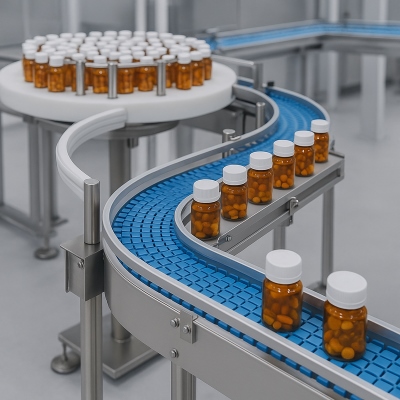
Best for: Bottles, jars, ampoules
- Low-vibration chain profiles
- Zero-pressure accumulation
- Complex curves and elevation changes
- Back-pressure control for fillers and cappers
- Static-dissipative chain options to prevent dust attraction
- Controlled merge and divert sections
Modular Plastic Belt Conveyors
Best for: Washdown areas, heavy loads, and multi-directional layouts
- High tensile strength
- Open-grid designs for drainage
- Fully stainless, hygienic frame designs
- Side-flexing options for S-curves
- Suitable for high-volume cleaning and chemical exposure
Roller Conveyors
Best for: Cartons, cases, and tertiary packaging
- Powered or gravity systems
- Low-maintenance, low-noise rollers
- Pallet-ready solutions
- Integration with print-and-apply labellers and case sealers
Specialised Pharma Conveyors
- Spiral conveyors for vertical travel
- Airflow-controlled conveyors for sterile environments
- Lift-gate sections for operator access
- Vision inspection conveyors with controlled illumination
- Reject conveyors with fail-safe verification
- Controlled-environment conveyors for humidity-sensitive products
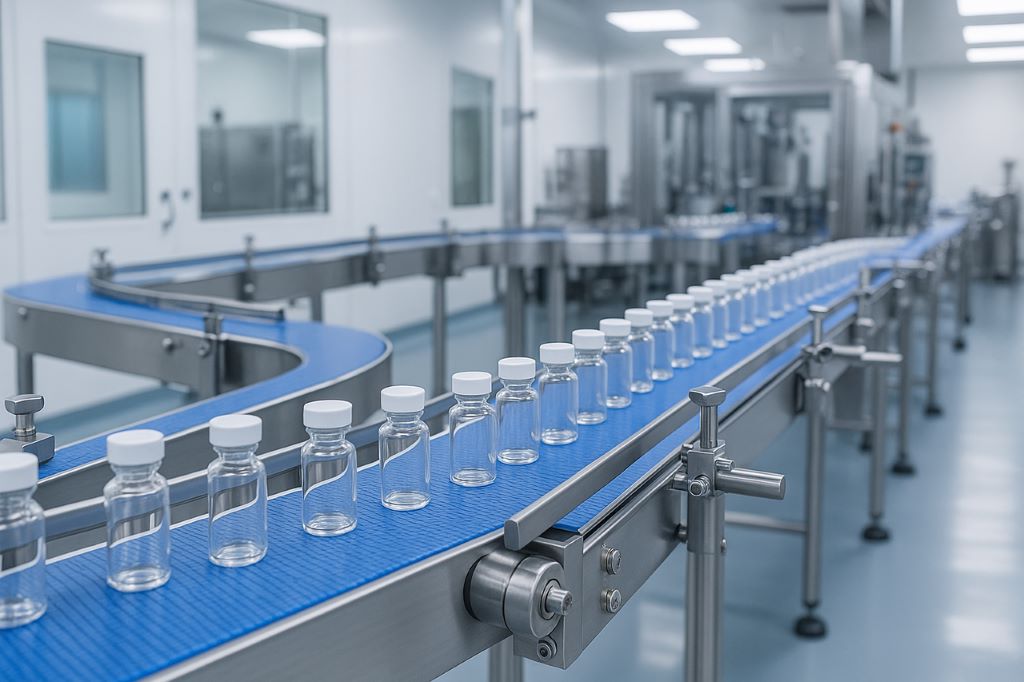
Engineering Considerations Specific to Pharma (Where Many Systems Fail)
Hygienic Design Principles
We follow EHEDG-aligned design thinking:
- No flat surfaces
- Full welds, no threaded inserts
- Minimal fasteners within product zones
- FDA, EU 10/2011 and cGMP approved materials only
- Smooth radius bends
- IP69K-capable components where required
Transfer Geometry
Most rejects and jams occur here. We have experience in engineering:
- Nosebars down to 5–8 mm radius
- Transfer rollers as small as 16 mm
- Vacuum belt sections for extremely light products
- Synchronized servo transfers
Static Management
Critical for plastic bottles and lightweight components, these systems include:
- Static-dissipative belts
- Ionising bars
- Grounded frame designs
Speed & Line Control
Mismatch between machines produces product gaps or compression. Our systems include:
- Servo-driven motors
- VFD controls
- Dynamic accumulation
- Intelligent line-balancing logic
Cleaning & Maintenance Accessibility
Tool-less removal, open-frame design, reversible belt runs and sealed bearings reduce downtime.
Our Engineering & Validation Process
- Site Survey & Material Flow Analysis
- 3D Modelling & Line Simulation
- Hygienic and Structural Design Engineering
- Factory Acceptance Testing (FAT)
- Installation & Integration
- Site Acceptance Testing (SAT)
- Support for IQ/OQ Documentation
- Lifetime Service & Optimisation
Contact us Today
We engineer and build conveyor systems for pharmaceutical, nutraceutical, biotech and medical device facilities across the UK and Europe. Whether you need a cleanroom-compatible belt conveyor, a multi-level slat chain system or a fully integrated line, our engineering team can design, validate, and maintain a system built around your exact production requirements